
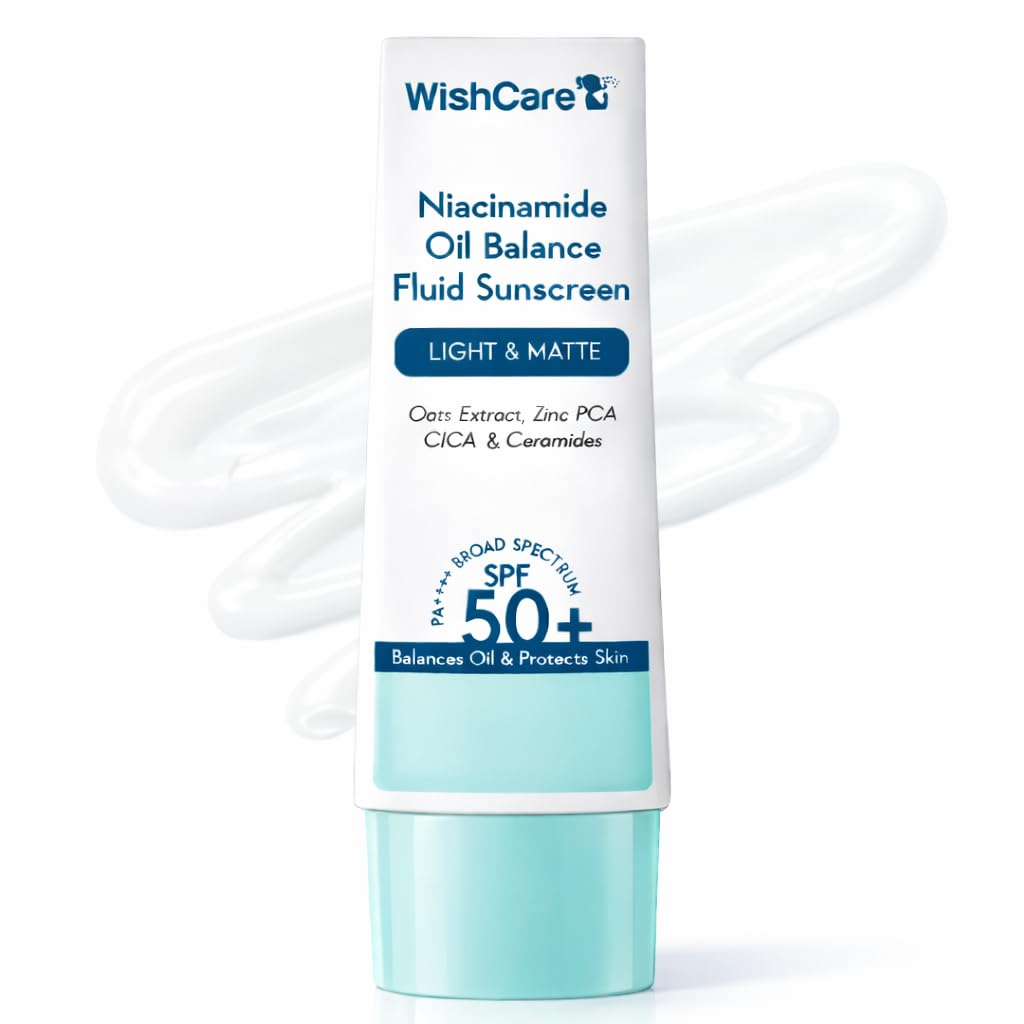
WishCare

Niacinamide Oil Balance Fluid Sunscreen SPF 50

Excellent broad-spectrum UV protection.

Hybrid Chemical DominantFluid
Buy on Amazon

Skin Type Match

55%

Soothing · Matte · Unscented

Pros
  • Strong calming complex
  • Zero synthetic fragrance
  • Restores skin barrier
Cons
  • Powdery matte finish
  • Chemical filter irritation
  • Severe eye sting
View other sunscreens for Dry Skin with Rosacea

Performance Scores

SPF Level
The labelled SPF 50 maps directly to the 'Very high' protection tier, corroborated by a robust blend of organic and inorganic UVB filters.
Broad Spectrum
Excellent broad-spectrum coverage is achieved through a multi-filter system, with Avobenzone and Zinc Oxide robustly covering the critical UVA I range, complemented by Octocrylene and Titanium Dioxide for UVA II.
Sweat Resistance
The product makes no formal water resistance claim and features only minimal film-forming infrastructure, relying mostly on standard rheology modifiers and volatile silicones.
Visible Light
The formulation completely lacks iron oxides or dedicated tinting agents necessary to meaningfully attenuate visible light and high-energy visible (blue) light.
Irritation Risk
Contains multiple chemical UV filters that can trigger contact dermatitis, though the risk is offset by a robust blend of soothing agents.
Pore Clogging
The formulation is built primarily on non-comedogenic water, silicones, and synthetic UV filters, with only minor lipids like octyldodecanol and sorbitan olivate present in the lower half of the ingredient list.
White Cast
A primarily chemical filter formulation with mineral filters (zinc oxide, titanium dioxide) relegated to positions 16 and 17, minimizing cast risk.

Ingredients Analysis

Active Filters

OctisalateChemical · UVB
Clinical trials demonstrate systemic absorption into the bloodstream exceeding the FDA threshold requiring further safety testing.
AvobenzoneChemical · UVA I/UVA II
Rapidly degrades under UV exposure losing significant UVA protection capacity unless stabilized by other filters.
OctocryleneChemical · UVB/UVA II
Banned in several jurisdictions due to evidence of coral toxicity and accumulation in marine life.
HomosalateChemical · UVB
Laboratory studies indicate homosalate may act as an endocrine disruptor by interfering with hormone systems [1.1].
Zinc OxideMineral · Broad Spectrum UV/High Energy Visible
Titanium DioxideMineral · UVB/UVA II
Classified as a possible human carcinogen if inhaled making spray and powder formulations a potential risk while dermal application remains safe

Key Inactives

WaterWater · Solvent
CyclopentasiloxaneSilicone · Emollient
The European Union is restricting this ingredient to a maximum concentration of one tenth of a percent in leave on cosmetics effective June 2027.
NiacinamideVitamin · Antioxidant
SilicaMattifying Agent · Sensory Modifier
Butylene GlycolGlycol · Solvent
GlycerinGlycerin · Humectant
Tapioca StarchMattifying Agent · Sensory Modifier
Neopentyl Glycol DiheptanoateFatty Acid Ester · Emollient
AMPS/HEMA Crosspolymer and C13-15 Alkane and Coco-GlucosidePolymeric · Thickener
OctyldodecanolSynthetic Oil · Emollient
Polysorbate 20Solubilizer · Surfactant
As an ethoxylated ingredient, it may contain trace amounts of 1,4 dioxane and ethylene oxide, which are potential carcinogens linked to the manufacturing process.
Oat ExtractBotanical Extract · Skin Conditioning
Although generally hypoallergenic repeated topical application of oat proteins on severely compromised skin such as in children with atopic dermatitis may increase the risk of epicutaneous sensitization [1.5].
Zinc PCAAmino Acid · Humectant
Cetearyl Olivate and Sorbitan OlivateNonionic · Emulsifier
Ceramide APCeramide · Skin Conditioning
Ceramide NPCeramide · Skin Conditioning
Ceramide EOSCeramide · Skin Conditioning
PanthenolOther · Humectant
Centella Asiatica ExtractBotanical Extract · Skin Conditioning
EthylhexylglycerinMultifunctional · Preservative
Recognized as a rare but emerging cause of allergic contact dermatitis, particularly in leave-on cosmetic products.
PhenoxyethanolPhenoxyethanol · Preservative
Generally well tolerated but can cause contact dermatitis or skin irritation in rare cases, particularly in sensitive individuals.
Coco-GlucosideCleansing · Surfactant
Alkyl glucosides are recognized as emerging contact allergens that can cause allergic contact dermatitis particularly in individuals with compromised skin barriers [1.3].
Xanthan GumGum · Thickener
Tocopheryl AcetateVitamin · Antioxidant
Hyaluronic AcidHyaluronic Acid · Humectant
Citric AcidAcid · pH Adjuster